
The "Glass Box" Hack: Why a Building in Public Strategy Beats Big Corp Budgets
- Grow Millions
- Jan 29
- 4 min read

The unfair advantage of being human
If you are running a bootstrapped startup, you are fighting an asymmetric war. Your biggest competitors have marketing budgets that eclipse your entire lifetime revenue. They have armies of SDRs, glossy Super Bowl ads, and brand recognition that took decades to build.
Trying to out-spend or out-polish them is a losing battle. But giant corporate monoliths have a critical weakness: they are soulless. They are opaque black boxes.
As a bootstrapper, you have a unique advantage that they are terrified to use: your humanity. You can operate inside a "Glass Box."
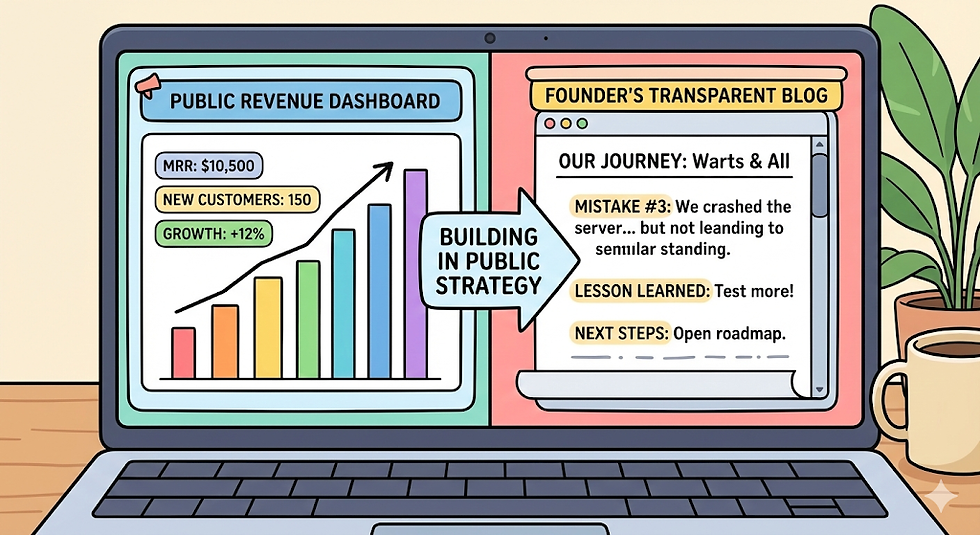
By adopting a building in public strategy, you can turn your lack of resources into your greatest marketing asset. Instead of hiding your struggles, your revenue numbers, and your buggy code, you broadcast them.
This sounds terrifying. Yet, this radical transparency weaponizes vulnerability to build trust faster than any million-dollar ad campaign ever could. It turns customers into cheerleaders and prospects into loyal community members.
Here is why the "Glass Box" approach works, the psychology behind it, and how to execute a building in public strategy without ruining your reputation.
The psychology behind the "Glass Box"
Why would anyone buy from a company that admits it just crashed its production server?
Conventional business wisdom says you should project an image of flawless invincibility. But behavioral psychology tells a different story.
There is a psychological phenomenon known as the Pratfall Effect. Research shows that people who are generally considered competent become more likable and trustworthy when they make a mistake or admit a flaw.
Perfection is intimidating and, frankly, suspicious. We know the world is messy. When a massive corporation pretends everything is perfect, our BS detectors go off. We wonder what they are hiding in the black box.
When a founder executes a transparent building in public strategy, they are leveraging the Pratfall Effect. When you share that you messed up a feature launch, you aren't just sharing failure; you are demonstrating honesty.
In a digital world drowning in fake news and polished Instagram realities, honesty is the rarest and most valuable currency.
Humans prefer buying from struggling humans
People do not have emotional connections with logos. They have emotional connections with other people.
When you buy software from Microsoft or Salesforce, it is a transaction. When you buy software from a bootstrapped founder whose journey you have followed on Twitter for six months, it is support.
A well-executed building in public strategy transforms your customer relationship. You cease to be just another vendor clamoring for their credit card. You become a protagonist in a story they are invested in.
When you share your Monthly Recurring Revenue (MRR) milestones, your community celebrates with you. When you share your anxieties about a new competitor, they rally to defend you. They want you to win because they feel like they know you.
This emotional moat is something a well-funded competitor cannot buy. They can copy your features, undercut your pricing, and poach your engineers. But they cannot copy the authentic human connection you have built through radical transparency.
Tactical execution of a building in public strategy
Embracing the "Glass Box" doesn't mean overselling your diary. It means being strategic about what you share to build trust and demonstrate competence over time.
Here are three practical ways to implement a building in public strategy.
1. The Public Product Roadmap
Most companies hide their roadmaps because they are afraid of commitment or competitive espionage.
The transparent alternative is a public Trello board or Notion page showing exactly what you are working on, what is planned next, and even what you have decided not to build.
This builds immense trust with existing users. They feel heard. It also manages expectations better than any vague "it's on the roadmap" email ever could. Prospects see a living, breathing product that is actively being improved.
2. The "Post-Mortem" Blog Post
When big companies fail, they issue sterile PR statements written by lawyers. When bootstrappers fail, they should write detailed post-mortems.
Did a new feature flop? Did your site go down for four hours on Black Friday?
Write a blog post explaining exactly what happened, why it happened, how you fixed it, and what systems you put in place to ensure it never happens again. This doesn't make you look incompetent; it makes you look accountable and resilient. It shows you are serious about improvement.
3. The "Open Startup" Metrics
This is the most extreme version of a building in public strategy. It involves sharing your core business metrics—revenue, churn, user counts—live on a public dashboard.
While daunting, this signals absolute confidence in your product and your journey. It attracts a specific type of early adopter who appreciates the raw honesty of the "indie hacker" movement.
Navigating Enterprise Fears
A common objection is that a building in public strategy will scare away serious enterprise clients who want stability, not vulnerability.
This is a valid concern, but it is manageable. Transparency does not mean unprofessionalism.
You can be transparent about your process without being messy about your operations.
Enterprise clients want to know two things: Are you competent, and will you be around in three years?
You can use transparency to prove both. Sharing a detailed technical post-mortem of an outage demonstrates high-level engineering competence. Sharing your steady, profitable (even if slow) growth metrics proves financial sustainability better than a VC-backed startup burning millions a month.
At Growmillions.in, we often advise founders on how to strike this balance. We help craft narratives that use transparency to build trust with early adopters while maintaining the necessary air of professionalism for larger deals. You can see how we approach this in our guides on creating trustworthy [Internal Link: startup pitch decks].
Conclusion
The "Glass Box" is not for everyone. It requires a thick skin and a genuine commitment to honesty.
But for bootstrapped founders facing down giants, it is the ultimate equalizer. By adopting a building in public strategy, you stop competing on their terms (budget and polish) and start competing on yours (humanity and trust).
In a world of faceless corporations, being the company with a face is a massive competitive advantage. Smash the black box and let them see inside.


Comments